Connect with us

Business

2026 will be the year you get fooled by a deepfake, researcher says. Voice cloning has crossed the ‘indistinguishable threshold’

Published

on


Over the course of 2025, deepfakes improved dramatically. AI-generated faces, voices and full-body performances that mimic real people increased in quality far beyond what even many experts expected would be the case just a few years ago. They were also increasingly used to deceive people.

For many everyday scenarios — especially low-resolution video calls and media shared on social media platforms — their realism is now high enough to reliably fool nonexpert viewers. In practical terms, synthetic media have become indistinguishable from authentic recordings for ordinary people and, in some cases, even for institutions.

And this surge is not limited to quality. The volume of deepfakes has grown explosively: Cybersecurity firm DeepStrike estimates an increase from roughly 500,000 online deepfakes in 2023 to about 8 million in 2025, with annual growth nearing 900%.

I’m a computer scientist who researches deepfakes and other synthetic media. From my vantage point, I see that the situation is likely to get worse in 2026 as deepfakes become synthetic performers capable of reacting to people in real time. https://www.youtube.com/embed/2DhHxitgzX0?wmode=transparent&start=0 Just about anyone can now make a deepfake video.

Dramatic improvements

Several technical shifts underlie this dramatic escalation. First, video realism made a significant leap thanks to video generation models designed specifically to maintain temporal consistency. These models produce videos that have coherent motion, consistent identities of the people portrayed, and content that makes sense from one frame to the next. The models disentangle the information related to representing a person’s identity from the information about motion so that the same motion can be mapped to different identities, or the same identity can have multiple types of motions.

These models produce stable, coherent faces without the flicker, warping or structural distortions around the eyes and jawline that once served as reliable forensic evidence of deepfakes.

Second, voice cloning has crossed what I would call the “indistinguishable threshold.” A few seconds of audio now suffice to generate a convincing clone – complete with natural intonation, rhythm, emphasis, emotion, pauses and breathing noise. This capability is already fueling large-scale fraud. Some major retailers report receiving over 1,000 AI-generated scam calls per day. The perceptual tells that once gave away synthetic voices have largely disappeared.

Third, consumer tools have pushed the technical barrier almost to zero. Upgrades from OpenAI’s Sora 2 and Google’s Veo 3 and a wave of startups mean that anyone can describe an idea, let a large language model such as OpenAI’s ChatGPT or Google’s Gemini draft a script, and generate polished audio-visual media in minutes. AI agents can automate the entire process. The capacity to generate coherent, storyline-driven deepfakes at a large scale has effectively been democratized.

This combination of surging quantity and personas that are nearly indistinguishable from real humans creates serious challenges for detecting deepfakes, especially in a media environment where people’s attention is fragmented and content moves faster than it can be verified. There has already been real-world harm – from misinformation to targeted harassment and financial scams – enabled by deepfakes that spread before people have a chance to realize what’s happening. https://www.youtube.com/embed/syNN38cu3Vw?wmode=transparent&start=0 AI researcher Hany Farid explains how deepfakes work and how good they’re getting.

The future is real time

Looking forward, the trajectory for next year is clear: Deepfakes are moving toward real-time synthesis that can produce videos that closely resemble the nuances of a human’s appearance, making it easier for them to evade detection systems. The frontier is shifting from static visual realism to temporal and behavioral coherence: models that generate live or near-live content rather than pre-rendered clips.

Identity modeling is converging into unified systems that capture not just how a person looks, but how they move, sound and speak across contexts. The result goes beyond “this resembles person X,” to “this behaves like person X over time.” I expect entire video-call participants to be synthesized in real time; interactive AI-driven actors whose faces, voices and mannerisms adapt instantly to a prompt; and scammers deploying responsive avatars rather than fixed videos.

As these capabilities mature, the perceptual gap between synthetic and authentic human media will continue to narrow. The meaningful line of defense will shift away from human judgment. Instead, it will depend on infrastructure-level protections. These include secure provenance such as media signed cryptographically, and AI content tools that use the Coalition for Content Provenance and Authenticity specifications. It will also depend on multimodal forensic tools such as my lab’s Deepfake-o-Meter.

Simply looking harder at pixels will no longer be adequate.

Siwei Lyu, Professor of Computer Science and Engineering; Director, UB Media Forensic Lab, University at Buffalo

This article is republished from The Conversation under a Creative Commons license. Read the original article.

This story was originally featured on Fortune.com


Source link

Continue Reading

Business

Winter storm cancels more than 1,000 flights in the Northeast and Great Lakes regions as state of emergency declared in N.Y., N.J.

Published

on


More than a thousand flights were canceled or delayed across the Northeast and Great Lakes regions due to snow as thousands took to U.S. roads and airports during the busy travel period between Christmas and New Year’s.

As of Saturday morning, New York City had received just under three inches of snow — roughly half of what some forecasts had predicted. At least 1,500 flights were canceled from Friday night into Saturday, according to flight-tracking service FlightAware.

Newark Liberty International Airport, John F. Kennedy International Airport and LaGuardia Airport posted snow warnings on the social media platform X on Friday, cautioning that weather conditions could cause flight disruptions.

The National Weather Service warned of hazardous travel conditions from the Great Lakes through the northern mid-Atlantic and southern New England, with the potential for tree damage and power outages. Forecasters said the storm was expected to weaken by Saturday morning.

Ahead of the storm, New York Gov. Kathy Hochul declared a state of emergency for more than half of the state. Acting New Jersey Gov. Tahesha Way declared a state of emergency for all of New Jersey, “due to a severe winter storm causing dangerous weather conditions, including heavy snow, sleet, and freezing rain.”

“This storm will cause dangerous road conditions and impact holiday travel,” Way said in a statement. “We are urging travelers to avoid travel during the storm and allow crews to tend to the roads. Drivers should plan their travel accordingly, monitor conditions and road closures, and follow all safety protocols.”

This story was originally featured on Fortune.com


Source link

Continue Reading

Business

California drops lawsuit to reinstate federal bullet train funding as high-speed rail authority seeks private investors

Published

on


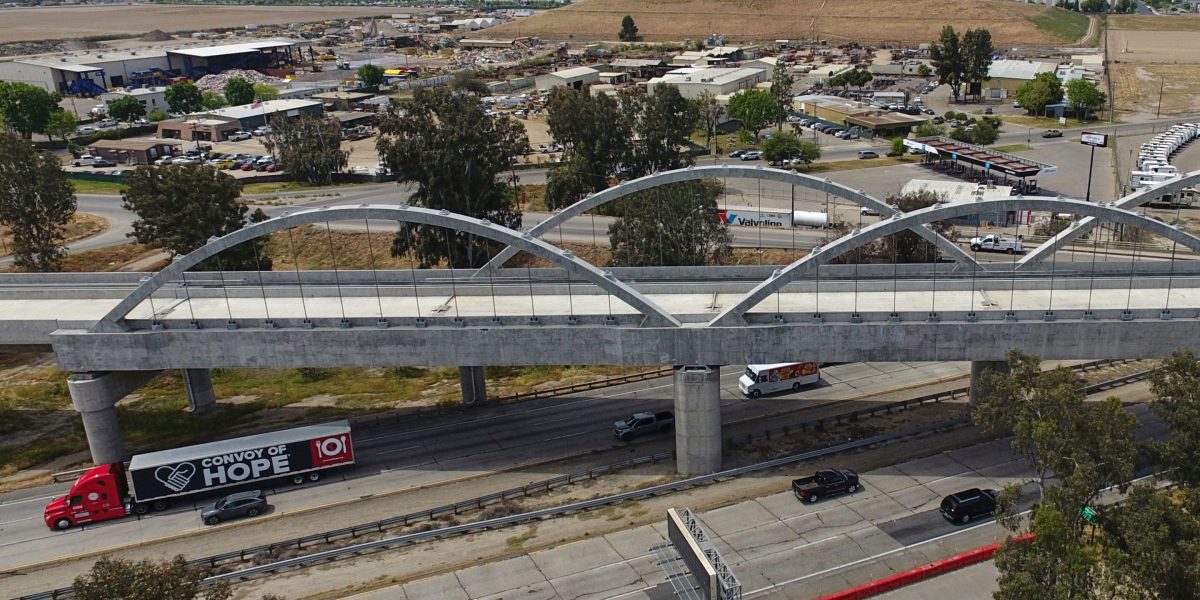
California this week dropped a lawsuit officials filed against the Trump administration over the federal government’s withdrawing of $4 billion for the state’s long-delayed high-speed rail project.

The U.S. Transportation Department slashed funds for the bullet train aimed at connecting San Francisco to Los Angeles in July. The Trump administration has said the California High-Speed Rail Authority had “ no viable plan ” to complete a large segment of the project in the farm-rich Central Valley.

The authority quickly filed a lawsuit, with Democratic Gov. Gavin Newsom calling the federal government’s decision “a political stunt to punish California.”

The authority said this week that it would focus on other funding sources to complete the project, which is estimated to cost more than $100 billion.

“This action reflects the State’s assessment that the federal government is not a reliable, constructive, or trustworthy partner in advancing high-speed rail in California,” an authority spokesperson said in a statement.

The Transportation Department did not respond to a request for comment. President Donald Trump and Transportation Secretary Sean Duffy have both previously criticized the project as a “train to nowhere.”

“The Railroad we were promised still does not exist, and never will,” Trump said on his social media platform Truth Social in July. “This project was Severely Overpriced, Overregulated, and NEVER DELIVERED.”

The authority’s decision to drop the lawsuit comes as the group seeks private investors to support the bullet train. The project recently secured $1 billion in annual funding from the state’s cap-and-trade program through 2045.

The program sets a declining limit on total planet-warming emissions in the state from major polluters. Companies must reduce their emissions, buy allowances from the state or other businesses, or fund projects aimed at offsetting their emissions. Money the state receives from the sales funds climate-change mitigation, affordable housing and transportation projects, as well as utility bill credits for Californians.

The rail authority said its shift in focus away from federal funding offers “a new opportunity.”

“Moving forward without the Trump administration’s involvement allows the Authority to pursue proven global best practices used successfully by modern high-speed rail systems around the world,” a spokesperson said in a statement.

This story was originally featured on Fortune.com


Source link
Continue Reading

Business

Kennedy Center seeks $1 million in damages from musician who canceled show after Trump name added

Published

on


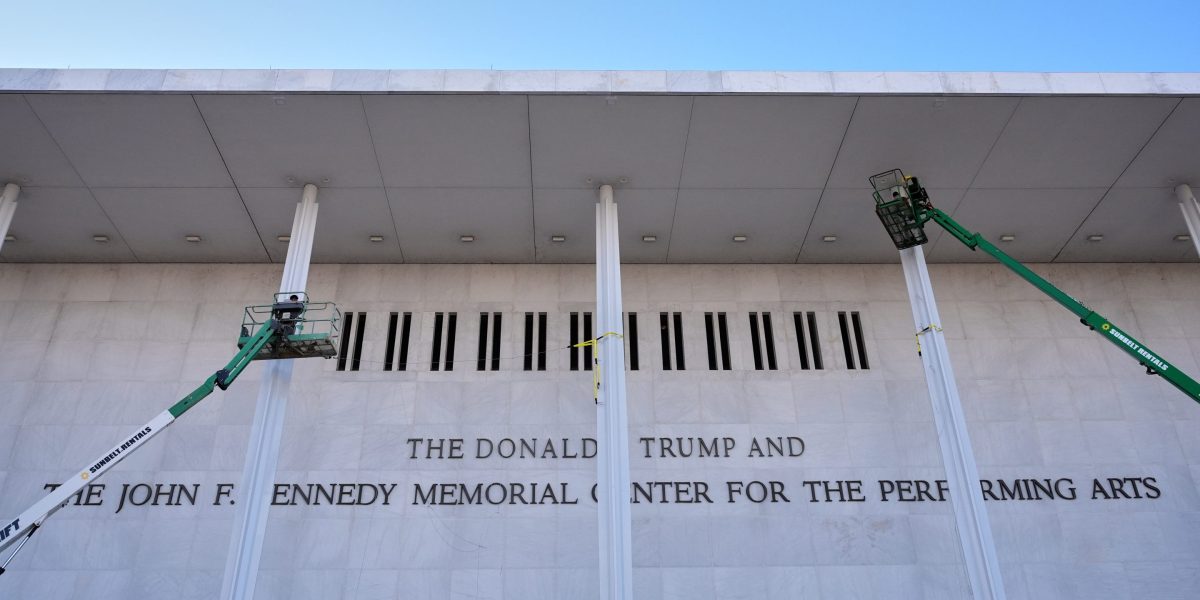
The president of the Kennedy Center on Friday fiercely criticized a musician’s sudden decision to cancel a Christmas Eve performance at the venue days after the White House announced that President Donald Trump’s name would be added to the facility.

“Your decision to withdraw at the last moment — explicitly in response to the Center’s recent renaming, which honors President Trump’s extraordinary efforts to save this national treasure — is classic intolerance and very costly to a non-profit Arts institution,” the venue’s president, Richard Grenell, wrote in a letter to musician Chuck Redd that was shared with The Associated Press.

In the letter, Grenell said he would seek $1 million in damages “for this political stunt.”

Redd did not immediately respond to a request for comment.

A drummer and vibraphone player, Redd has presided over holiday “Jazz Jams” at the Kennedy Center since 2006, succeeding bassist William “Keter” Betts. In an email Wednesday to The Associated Press, Redd said he pulled out of the concert in the wake of the renaming.

“When I saw the name change on the Kennedy Center website and then hours later on the building, I chose to cancel our concert,” Redd said. He added Wednesday that the event has been a “very popular holiday tradition” and that he often featured at least one student musician.

“One of the many reasons that it was very sad to have had to cancel,” he told the AP.

President John F. Kennedy was assassinated in 1963, and Congress passed a law the following year naming the center as a living memorial to him.

Grenell is a Trump ally whom the president chose to head the Kennedy Center after he forced out the previous leadership. According to the White House, Trump’s handpicked board approved the renaming, which scholars have said violates the law. Kennedy niece Kerry Kennedy has vowed to remove Trump’s name from the building once he leaves office, and former House historian Ray Smock is among those who say any changes would have to be approved by Congress.

The law explicitly prohibits the board of trustees from making the center into a memorial to anyone else, and from putting another person’s name on the building’s exterior.


Source link

Continue Reading

Trending

Copyright © Miami Select.